In our most recent First Things we explored the nature of the liberal arts and their role within classical Christian education. By way of review, the liberal arts include the seven subjects of grammar, logic, rhetoric, arithmetic, geometry, astronomy, and music. The first three—grammar, logic, and rhetoric—make up what has been called The Trivium or the “three ways.” We will turn to the remaining four ways, also called the Quadrivium, in our next First Things. When most parents or educators encounter classical education for the first time, they hear about the Trivium of grammar, dialectic or logic, and rhetoric. It is to these that we turn our attention today.
Let’s once again start with our definition of classical education:
“Classical education is the pursuit of wisdom through a cultivation of intellectual virtue and an encouragement of moral virtue by means of habits rooted in the historic scholastic practices of the Church and the West and by a rich and ordered course of study, grounded in the liberal arts; ascending through humane letters, mathematics, natural science, philosophy, and theology; and yielding informed self-rule and a well-ordered understanding of human nature, the cosmos, and God. It is aimed at the thoughts and desires of heart, soul, and mind (the whole person) for Christ and his Kingdom.”
The liberal arts are the tools of learning through which arguments, poems, and proofs are uncovered. They provide the tools through which science is demonstrated and the paths by which reality is encountered.
The Trivium, the most familiar liberal arts category for most classical school parents and teachers, is the threefold curriculum of the language arts at Capstone and in all classical schools: grammar, logic or dialectic, and rhetoric. It is the foundation of a classical education. Grammar has to do with understanding language, logic with reasoning, and rhetoric with artful composition of texts, written and spoken. All subsequent learning proceeds from language. Aristotle identified man as the rational animal, but since we reason in words, it is reasonable to say that man’s essential property, differentiating him from all living things, is the capacity for speech. This is not just a matter of communication but the artful use of words. All sorts of living things communicate in various ways, but as Kevin Clark and Ravi Jain put it in The Liberal Arts Tradition, “Only the living being with logos (words) uses words to create, to change reality, to exercise authority, to lead men’s souls.” The Trivium of grammar, logic, and rhetoric, then, cultivate the human potential that derives from the fact that we have language.
Grammar may be the only one of the first three liberal arts that still has even a modest place in progressive (non-classical) schools. Even there it hardly holds a prominent place and is reduced to the rules of language. In classical schools, we understand grammar as the art of feeling at home in language. It is a way of dwelling in culture by learning to speak, hear, read, and write. In our school, studying the rules of formal language follows the students’ immersion in the language of beautiful exemplars through music, literature, and recitation of great authors, orators, and thinkers. Through listening, admiring, memorizing, and meditating upon great written words, students become imitators of great language that expresses great goodness, truth, and beauty and begin to develop an instinct for good speaking and writing, which are also good thinking. Once a young human has been formed by great language, we can turn our attention toward teaching them the rules of the system that makes great language work the way it does. This formal study of grammar is what most Americans think of when we speak of teaching grammar, but taught by itself, it is a faint shadow of the grammar’s riches, which should include cultivating a student’s memory and imagination through listening, reciting, and imitating. After seeing the world through language, we turn our attention in formal grammar instruction to the language itself. To skip the first steps is to malnourish the human by neglecting most of their faculties, indeed even their humanity, by reducing them to mechanistic analysts and rule followers.
The second art in the Trivium is logic or dialectic. We’ll refer to it as logic as the term is most familiar to our audience, but the two terms can be used interchangeably to name the liberal art that teaches students to follow questions and find arguments. Formal logic involves determining whether an inference or conclusion follows from a premise in an argument. But in classical schools and the liberal arts, logic means more than simply evaluating formal arguments. The word dialectic is often used for this liberal art because in it we can see the etymological relationship to the word dialogue. Indeed, logic in the classical school involves much conversation! Plato’s Dialogues marked the beginning of the liberal art of logic in Western education. For Socrates, the main character in Plato’s Dialogues, logic was about asking the right questions, and he spends most of his time helping his students to ask the right questions. We might think of logic as the art of following one good question to the next logical question and so on. Often knowing the question that should be asked is the goal in logic, not having all the right answers—though that is important. If the right questions are not asked, the right answers will never be found. The right questions are foundational to learning what is good, true, and beautiful and are essential to being lifelong learners.
In the Middle Ages, medieval thinkers developed a wonderful literary form called disputatio, which was more than simply disputation or debate. In this exercise, a student or teacher would follow five steps: (1) Form a binary question such as “Does justice demand equal outcomes for all people?”, (2) Provide a summary of the leading authorities on the question, (3) Introduce another authority who argues well against the first point of view presented, (4) Attempt to synthesize the two points of view by finding congruence and reconciling differences between the first and second set of authorities, and (5) Respond to objections from the first point of view, showing how their view of reality was incomplete. St. Thomas Aquinas is an exemplar of this kind of dialectical or logical exercise. He uses it throughout his Summa Theologica. Yet one more reason why he has a place of prominence on the front of our building! As students rise from grammar school to upper school, more and more time is spent in logic and in such dialogues that teach our students to perceive good and bad counsel, to discover the relevant point at issue in a problem or question, and to weigh the counsels to determine the truth.
We finish up this week’s introduction to the Trivium or first three liberal arts with a look at rhetoric, the third art of language. Put simply, rhetoric is the art of making creative, persuasive, and productive use of language in public speech. It truly is the crown of the Trivium and is why it is so important for students who have received a classical education in grammar school to finish with a classical high school education. It is here that we form students in rhetoric. Without well-developed rhetorical understanding, grammar and logic don’t have the legs to run the good race of culture-making in the home, church, and community. Strong rhetoric matters for the sake of human flourishing and for the vital work of evangelism, parenting, and leadership in virtually every context. To artfully and winsomely present the good, true, and beautiful in our communities requires rhetoric.
Rhetoric has five parts or canons: Invention (discovering arguments to be used), arrangement (organizing the arguments well), style (choosing the best words for the audience and occasion), memory (a well-stocked mind with readily available content to use in the message), and delivery (skill at speaking well and fittingly for the audience and occasion). C.S. Lewis famously said that “speech is the power to create worlds.” Whether we realize it or not, we already create worlds and lead souls. Rhetoric liberates us to do it artfully, responsibly, and with both skill and virtue.
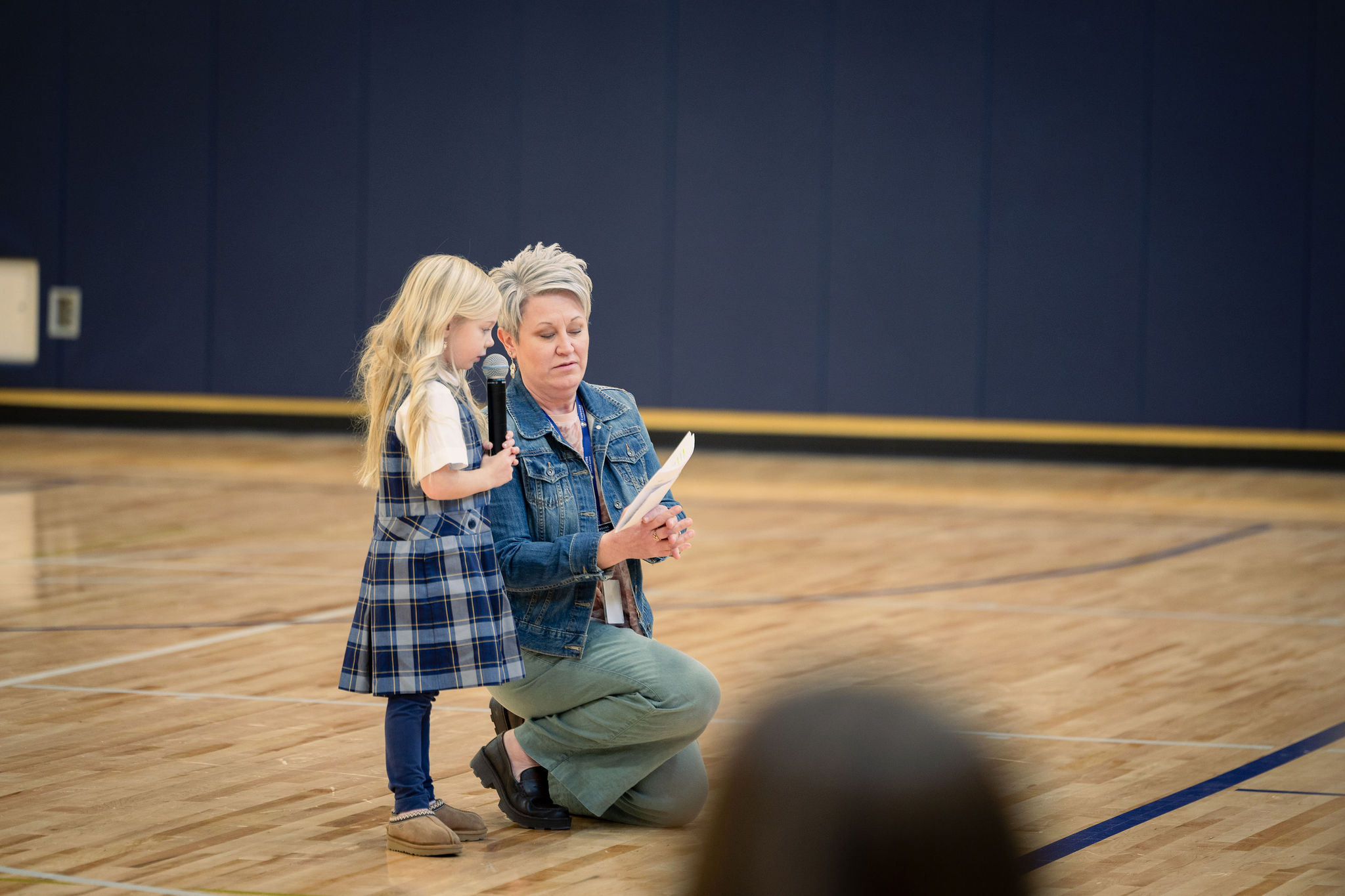
At Capstone, the students’ training in rhetoric begins even in PreK and kindergarten. In grammar school, students delight with their teachers in what is beautifully said and memorize much that is beautifully written. Copious oral reading, memorization, and recitation of stories, Scripture, poems, and even nursery rhymes are an essential part of filling students’ memory banks for their own rhetoric. Teachers model eloquent speech, both in structure and diction, and encourage students to imitate them and the authors they read. As students move into middle school grades, they keep commonplace notebooks where they collect well-said phrases and passages from their own reading and listening. In their writing curriculum, they practice imitating sentence structures, and in their grammar curriculum they diagram great sentences to better understand how a well-constructed thought functions in sentence form. As they move through upper school from middle to high school they produce more of their own written and spoken arguments, moving from imitation to application of formal rhetorical skills as they are taught rhetoric and begin to see how great thinkers, writers, and orators have used rhetorical skills to shape their world. The progression from dwelling in good rhetoric through great words from the past, imitating and expressing themselves from the classics stored up in their own minds, to carefully crafting persuasive words by trying out different arguments, forms, and methods of presentation leads to the very deepest understanding of content studied, which in the classical Christian school will be the most pressing questions of life.
If the Trivium of grammar, logic, and rhetoric were the only liberal arts taught at Capstone, they would be sufficient to differentiate our educational model from every school in our area, but in the next First Things we will explore the unique role of the other four liberal arts in the classical school.
Until next time, keep on pursuing the good, the true, and the beautiful to the glory of God and the good of your neighbor!