Parents have often told me that the early years of a classical education feel like a gift. Their children learn to read carefully, memorize poetry and Scripture, delight in stories of courage and sacrifice, and grow in wonder at the created world. These years are indeed beautiful. Yet for all of its goodness, grammar school students are only at the small beginning of something much larger—a long cultivation whose fruit appears most fully in the classical Christian high school.
A classical Christian education is not merely a collection of good classes. It is an ordered journey of formation. Like the growth of a sturdy oak tree, its earliest stages take place beneath the surface: roots extending quietly into deep soil. In the grammar years, students fill their minds with language, stories, facts, and Scripture. In the logic or middle school years, they learn to ask careful questions and to understand cause and effect. But it is in the rhetoric years—the final stage of the classical tradition—that these roots and branches finally produce fruit in the blossoming of wisdom and virtue possessed by winsome graduates.
The ancient educators understood this well. Aristotle wrote that “the aim of education is to make the pupil like and dislike what he ought.” In other words, true education shapes the heart as well as the mind. This takes time and must not be cut off after lower school or middle school. Likewise, the Roman educator Quintilian described the ideal student as “the good man speaking well.” The goal was not simply cleverness, but virtue expressed through wisdom and articulate speech. These goals take time. They require years of steady cultivation before they become habits of mind and character.
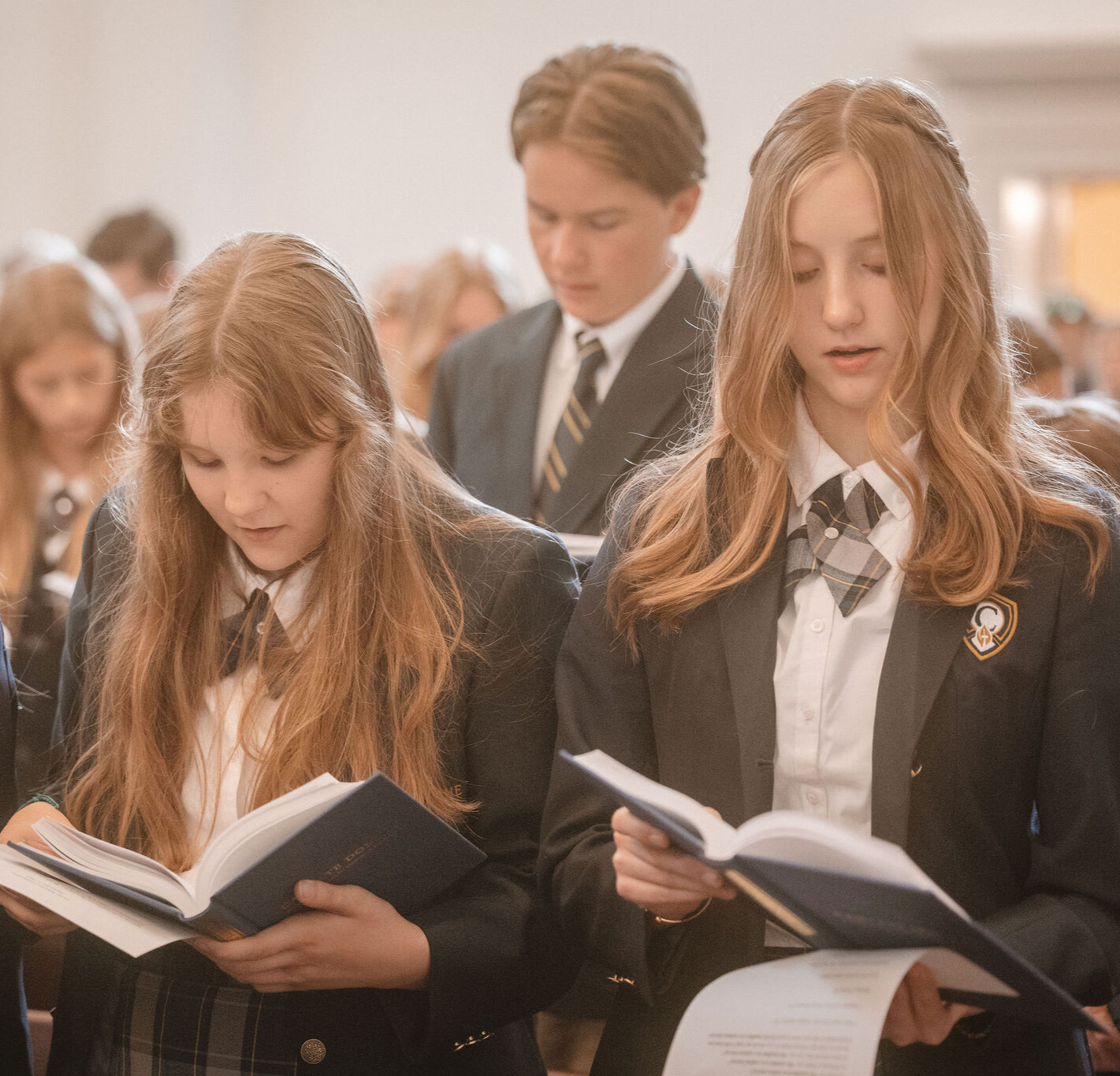
At Capstone and in classical schools across the country, the high school years are designed precisely for this culmination. Students do not merely repeat what they have learned before; they integrate it. Literature, history, theology, philosophy, mathematics, and science begin to speak to one another. The story of Western civilization becomes more than a timeline—it becomes a conversation across centuries about the nature of Truth, Goodness, and Beauty.
The high school years of classical education are especially important because in them students learn to synthesize their learning and express it with clarity and conviction. After years of reading great books, studying the Scriptures, examining the founding documents of our nation, and exploring the ideas that have shaped the world, students learn to articulate what they believe and why.
C. S. Lewis once warned of an education that produces what he called “men without chests”—students trained in technical skills but lacking the moral formation necessary for wise judgment. Classical Christian education seeks the opposite outcome. By the end of high school, students should possess what Lewis called “ordinate affections”—a rightly ordered love for truth, for God, and for their neighbors.
This is why finishing the full K–12 journey matters so deeply. The final years are where the scattered pieces of knowledge gathered in childhood become a coherent vision of reality. Students wrestle with the great theological questions of the faith. They study the philosophical traditions that shaped the Christian West. They read the Constitution and the Declaration of Independence alongside the biblical and classical ideas that influenced them. They examine history not merely as a sequence of events but as a record of the development of ideas—both good and bad, human choices, virtues, and failures.
In these years, students also learn to speak and write persuasively about what they have come to understand. Rhetoric, in the classical sense, is not manipulation or showmanship. It is the disciplined art of speaking truthfully and wisely for the good of others. As Augustine wrote in On Christian Doctrine, the Christian teacher must be able “to teach, to delight, and to move.” The rhetoric stage trains students to do exactly this—to communicate truth in ways that serve their communities and honor God.
For this reason, removing a student from a classical Christian education before its completion can unintentionally interrupt and even terminate the very process that parents began years earlier. The early stages plant seeds; the later stages cultivate fruit. To step away before the culmination can be a bit like cutting down a tree just as it begins to bear.
We understand that families make educational decisions for many reasons, and we approach this topic with humility. Every parent desires what is best for his or her child. Our encouragement is simply that the classical model works most fully when experienced as a whole. The lower, middle, and upper school stages form a single vision, each preparing the way for the next.
When students complete the full program, the results are often remarkable. Young men and women graduate not only with knowledge but with judgment. They have practiced listening carefully, weighing arguments, and speaking thoughtfully. They have encountered great ideas and tested them against the enduring truths of Scripture. They have learned that freedom requires virtue and that self-government begins with self-discipline.
The American founders understood this connection well. John Adams famously wrote that “our Constitution was made only for a moral and religious people. It is wholly inadequate to the government of any other.” A free society depends upon citizens capable of moral reasoning and responsible action. Classical Christian education seeks to prepare students for exactly this kind of citizenship.
But perhaps even more importantly, the goal is spiritual formation. Education in the Christian tradition ultimately points beyond career preparation or civic knowledge. It points toward wisdom—living rightly before God and neighbor.
The high school years of a classical Christian education are uniquely suited for this kind of formation. Students are old enough to wrestle with profound questions and young enough to be shaped by careful guidance. In thoughtful classrooms and respectful discussions, they begin to see how faith, reason, history, and culture fit together.
When this process reaches its completion, students leave not merely with diplomas but with a framework for life. They have encountered the great conversation of Western civilization and the enduring authority of Scripture. They have practiced reasoning about difficult questions and speaking with humility and courage. They have learned that truth is not invented but discovered.
Our hope, both at Capstone Classical Academy and within the broader classical school network, is that students graduate deeply rooted—intellectually, spiritually, and morally. Like the tree planted by streams of water in Psalm 1, their roots run deep enough to withstand the storms that life will surely bring.
And when those storms come—as they do for every generation—we pray that these students will stand firm, not because they were unnecessarily sheltered from the world, but because they were carefully prepared to navigate and shape it.
For parents who have begun this journey with their children, our encouragement is simple: consider the beauty of bringing it to completion. The seeds planted in the early years are meant to grow into wisdom, virtue, and faithful service. Finishing the course allows the work that began in Kindergarten or PreK to bear its intended fruit—for the good of the student, the family, the church, and the broader community.
Until next time, keep on pursuing the Good, the True, and the Beautiful to the glory of God and the benefit of your community.